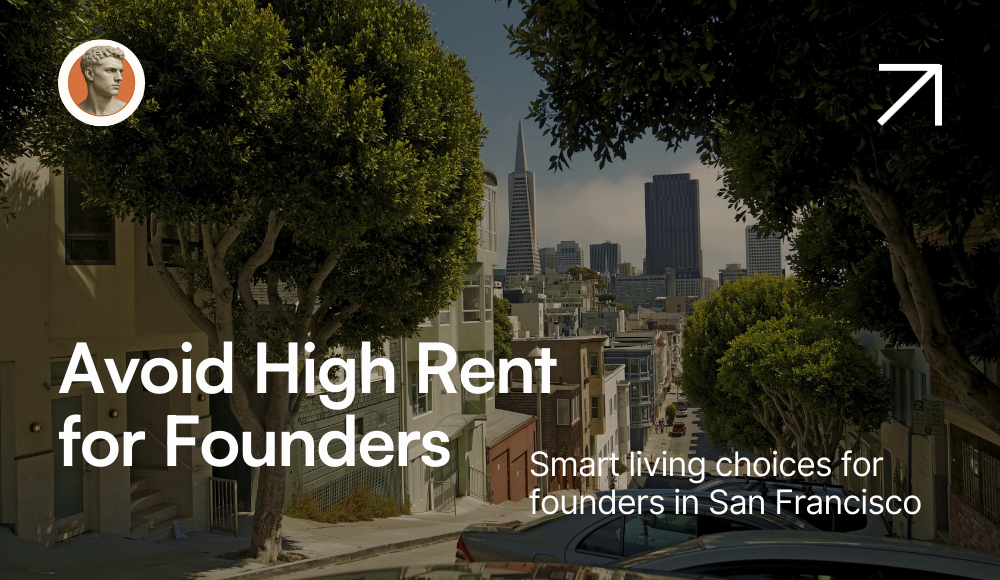
Most founders ask the wrong question before moving to San Francisco.
They ask, “Is SF still worth it?” That question is too abstract. A better question is: “If I move to San Francisco, will my first month turn into momentum, or will it disappear into housing, logistics, and random networking?”
That is the part nobody likes to price in. You can lose three weeks finding a room, buying basics, figuring out neighborhoods, going to events that do not matter, and trying to build a social graph from scratch. For a founder, that is not just inconvenient. It burns attention when attention is already scarce.
San Francisco can still be one of the best places in the world to build. But only if you land with intent.
The first month is where founders lose speed
The expensive part of SF is not only rent. It is the setup tax.
A founder lands with a plan: meet customers, find sharper peers, test an idea, raise, hire, or simply get out of a remote-work loop that has become too quiet. Then the city pushes back. Rooms are expensive. Sublets are inconsistent. Furniture is annoying. Events are noisy. Everyone says they are “building,” but not everyone is actually in the same season.
None of this is dramatic. That is the problem. The month does not collapse in one big mistake. It leaks away in small decisions.
This is why housing is not just housing for a founder. The place you live decides who you see every morning, what conversations happen by default, how much privacy you have, and whether your week has any rhythm beyond “work, scroll, event, repeat.”
Moving to SF to build?
Foundry gives founders and engineers a private furnished room, four SF house options, and a community rhythm built around dinners, events, and accountability.
What still makes San Francisco useful
SF is useful because the distance between useful people is shorter here.
A customer conversation can lead to a sharper positioning insight. A dinner can turn into a hiring lead. A founder working on an adjacent problem can save you from a mistake they made last month. A casual conversation can expose that your roadmap is too broad, your ICP is fuzzy, or your pitch is hiding the only interesting thing about the company.
The value is not magic. It is compression.
Remote work gives you reach. San Francisco gives you repeated contact with people who are actively making decisions under pressure. For early-stage founders, repeated contact matters because most company-building problems are not solved by one big meeting. They are shaped by many small corrections.
But density cuts both ways. SF also has low-signal events, expensive distractions, and plenty of people performing startup energy. The founder who benefits from the city is not the one who says yes to everything. It is the one who builds a useful weekly rhythm quickly.
What a good founder home base should remove
If you are comparing apartments, sublets, hacker houses, and founder coliving in San Francisco, do not start with aesthetics. Start with friction.
A useful founder home base should remove five things:
- Housing drag: furnished rooms, clear pricing, utilities, and a move-in process that does not eat the month.
- Social cold start: people around you who are also building, not just passing through SF.
- Event randomness: a house rhythm that creates useful conversations without forcing every night to become networking.
- Always-on chaos: a private room and calm shared spaces, so intensity does not become noise.
- Accountability drift: rituals that make it harder to disappear into vague work for two weeks.
This is the practical difference between “I found a room in SF” and “I landed in SF with a base.”
How Foundry fits today
Foundry is not the reason to move to San Francisco. The company reason comes first: customers, co-founder search, fundraising, hiring, or a build season that needs density.
What Foundry can do is make the landing cleaner. Today, Foundry operates four SF houses with private furnished rooms, founders and engineers in the community, guest dinners, events, and accountability-oriented rituals. The practical value is a base that reduces setup drag and puts serious builders within normal daily reach.
That is the difference between arriving with an address and arriving with a rhythm. Housing is the base layer; the community around it is where the momentum starts.
Who Foundry is for
Foundry is probably a fit if you are coming to San Francisco with a build season in mind.
- You are a founder, engineer, or early startup operator.
- You want a private room, not a hostel-style experience.
- You want to be around people who are actively building.
- You value dinners, events, and accountability, but you still need quiet time.
- You want SF proximity without spending the first month assembling a life from scratch.
Foundry is probably not a fit if you only want the cheapest possible bed, if you want a party house, or if you do not want your living environment connected to your work rhythm.
A simple decision rule
Move to San Francisco when being here makes the next 90 days more useful.
That might mean customer discovery. It might mean co-founder search. It might mean hiring. It might mean fundraising. It might mean getting out of isolation and back into a room where the default conversation is about what you are building and what you are avoiding.
Do not move because the city has mythology. Move because the next stage of the company benefits from density, feedback, and better defaults.
And when you compare housing options, ask the founder version of the question: “Will this place give me momentum, or just an address?”
Want a founder home base in San Francisco?
Browse Foundry houses, compare pricing, and see whether the current rooms match the season you are planning in SF.
If you are still deciding whether SF is the right move, read the guide to validating a startup idea in San Francisco and the piece on how founder coliving increases serious builder proximity. They are better next reads than another generic “move to SF” list.